The 2nd Challenge and Workshop for 4D Micro-Expression Analysis for Mind Reading (4DMR)
To be held at IJCAI-ECAI 2026, Bremen, Germany, on 15-17 of August 2026
Welcome to 4DMR Workshop & Challenge 2026
We jointly hold the second workshop and challenges for 4D Micro-Expression Analysis for Mind Reading (4DMR) at IJCAI-ECAI 2026, Bremen, Germany, on 15-17 of August 2026.
We warmly welcome your contribution and participation!
News
June 26 : Updated invited speaker information for Professor Hao Tang.
June 25 : Extended workshop abstract registration and paper submission deadlines by one week.
May 21 : Updated workshop submission guidelines and important dates.
May 18 : The workshop submission link is now available. Updated workshop important dates.
May 14 : Updated important dates for the workshop and challenge, as well as the workshop submission guidelines and invited speakers.
May 10 : Updated workshop important dates.
April 21 : The website for the 4DMR 2026 workshop and challenge is under construction...
Overview
We hold the 2nd 4DMR Workshop & Challenge to explore the application of 4D technologies in facial expression analysis, to be held at IJCAI-ECAI 2026, Bremen, Germany, on 15-17 of August 2026.
Humans display a vast array of emotional and cognitive states. The ability to interpret these states, often referred to as mind reading, is unparalleled in the animal kingdom and is fundamental to human social interaction and communication. A key component of mind reading is facial expression, which accounts for 55% of how we understand others' feelings and attitudes, playing a vital role in conveying essential information about mental states.
Micro-expressions (ME) are a special form of facial expressions which may occur when people try to hide their true feelings for some reasons. Unlike 2D and 3D methods, 4D analysis (3D mesh + temporal changes) excels at detecting fleeting micro-expressions.4D information can be leveraged to enhance accuracy and robustness of facial expression, effectively addressing challenges such as variations in lighting, pose, and noisy environments, making it ideal for real-world applications. Despite its promise, 4D facial expression research faces challenges that limit its progress.
This workshop aims to explore the application of 4D technologies in facial expression analysis. It will feature the inaugural 4D micro-expression recognition challenge to propel the field forward and provide a platform for researchers to benchmark their methodologies. The workshop will delve into cutting-edge techniques for both macro- and micro-expression recognition, discuss the implications of these methodologies for global communication and AI systems, and highlight practical applications in domains such as security, healthcare, and customer service. Interactive sessions with leading experts will foster deeper insights into how 4D facial expression analysis can revolutionize our understanding of human emotions and cognitive states.
Workshop Topics
-
This workshop explores advanced methodologies and applications of facial expression analysis for emotion understanding and mind reading across diverse scenarios and challenges. Topics of interest include, but are not limited to:
- Facial expressions (including micro- and macro-expressions) analysis for emotion understanding.
- 4D-based methodologies for facial expression understanding, e.g., classification, detection, online recognition, generation, and transferring.
- Psychological study and biologically-driven mechanism about facial expression and their links to mind reading.
- Solutions for special challenges involved with the in-the-wild facial expression analysis, e.g., high heterogeneous samples of interclass, face poeses, noisy backgrounds, etc.
- Applications of facial expressions recognition, e.g., for medical assessment in hospitals (ADHD, depression), for health surveillance at home or in other environments, for emotion assessment in various scenarios like for education, job interview, etc.
- Different modalities developed for mind reading, e.g., facial expressions, attentive gazes, and desensitized voices.
- New data collected for the purpose of mind reading.
- Applications of realistic facial expressions generation for human computer interaction or computer-mediated interactions.
References
- Li, Xiaobai, et al. "4DME: A spontaneous 4D micro-expression dataset with multimodalities." IEEE Transactions on Affective Computing (2022).
EasyChair Acknowledgement
This workshop uses EasyChair for managing paper submissions and the peer-review process.
Workshop Details
Introduction
Humans display a vast array of emotional and cognitive states. The ability to interpret these states, often referred to as mind reading, is unparalleled in the animal kingdom and is fundamental to human social interaction and communication. A key component of mind reading is facial expression, which accounts for 55% of how we understand others' feelings and attitudes, playing a vital role in conveying essential information about mental states.
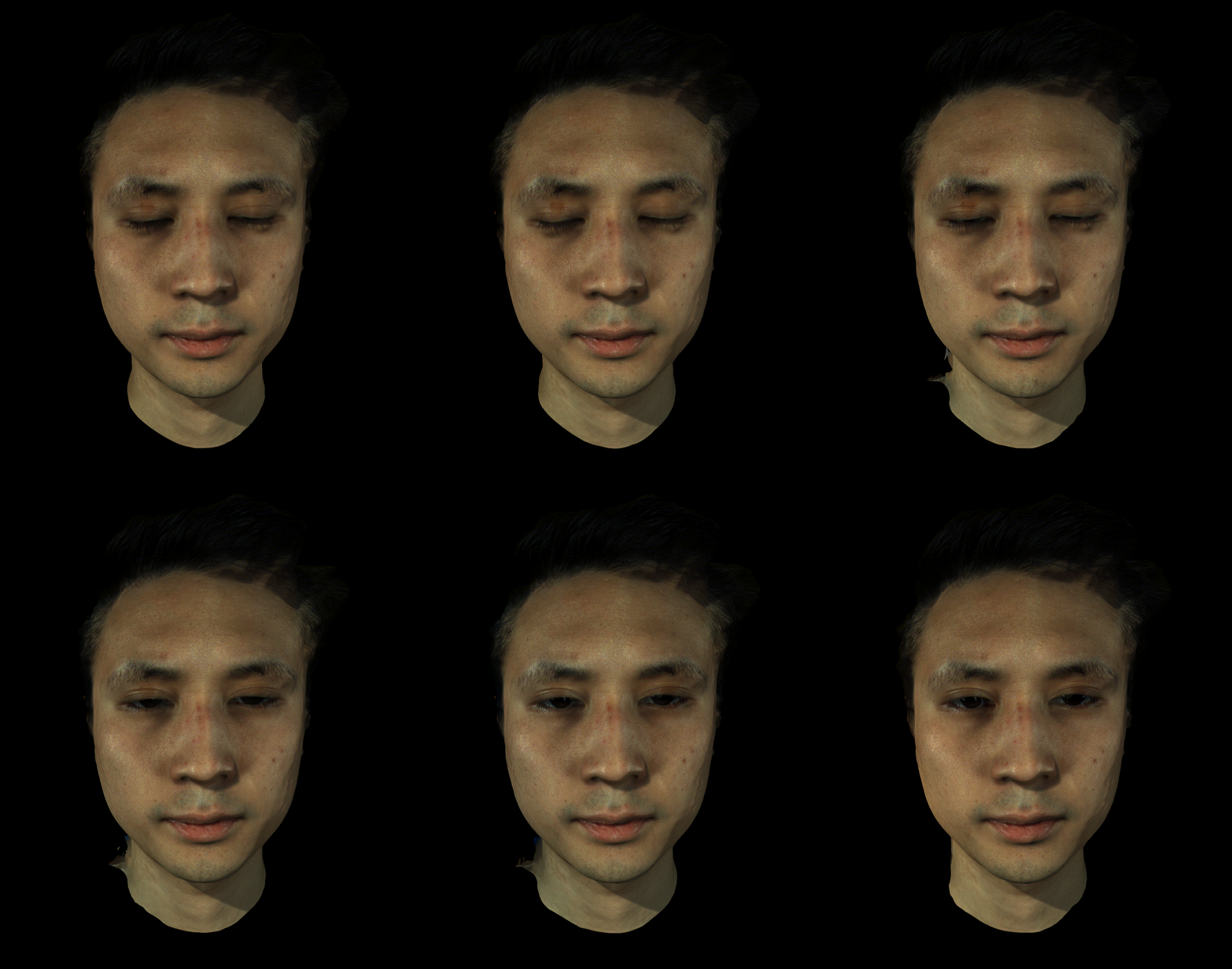
Fig. 1. 4D micro-expressions (3D mesh + temporal changes) examples.
To date, while extensive research has been conducted on facial expressions, the advent of 4D facial expression analysis marks a transformative leap in the field. By capturing the temporal evolution of expressions in three-dimensional space, 4D analysis reveals the intricate dynamics of facial muscle movements over time. Unlike 2D and 3D methods, 4D analysis (3D mesh + temporal changes) excels at detecting fleeting micro-expressions(Figure 1), which are brief, involuntary displays of hidden emotions by incorporating multiple views and temporal information for richer and more precise data. 4D information can be leveraged to enhance accuracy and robustness of facial expression, effectively addressing challenges such as variations in lighting, pose, and noisy environments, making it ideal for real-world applications. Despite its promise, 4D facial expression research faces challenges that limit its progress. The lack of diverse and realistic datasets, particularly for spontaneous micro-expressions, constrains its applicability to practical scenarios. Moreover, the computational demands of processing the complex temporal and spatial data inherent in 4D analysis pose significant technical challenges. Existing methodologies often struggle with capturing rapid and subtle micro-expressions and adapting to real-world conditions, such as occlusions, pose variations, and noisy backgrounds. Advancing the field requires the development of innovative algorithms, efficient computational techniques, and large-scale datasets to bridge these gaps, enabling applications in healthcare, security, and education.
This workshop aims to explore the application of 4D technologies in facial expression analysis. It will feature the inaugural 4D micro-expression recognition challenge to propel the field forward and provide a platform for researchers to benchmark their methodologies. The workshop will delve into cutting-edge techniques for both macro- and micro-expression recognition, discuss the implications of these methodologies for global communication and AI systems, and highlight practical applications in domains such as security, healthcare, and customer service. Interactive sessions with leading experts will foster deeper insights into how 4D facial expression analysis can revolutionize our understanding of human emotions and cognitive states.
Workshop Topics
-
This workshop explores advanced methodologies and applications of facial expression analysis for emotion understanding and mind reading across diverse scenarios and challenges. Topics of interest include, but are not limited to:
- Facial expressions (including micro- and macro-expressions) analysis for emotion understanding.
- 4D-based methodologies for facial expression understanding, e.g., classification, detection, online recognition, generation, and transferring.
- Psychological study and biologically-driven mechanism about facial expression and their links to mind reading.
- Solutions for special challenges involved with the in-the-wild facial expression analysis, e.g., high heterogeneous samples of interclass, face poeses, noisy backgrounds, etc.
- Applications of facial expressions recognition, e.g., for medical assessment in hospitals (ADHD, depression), for health surveillance at home or in other environments, for emotion assessment in various scenarios like for education, job interview, etc.
- Different modalities developed for mind reading, e.g., facial expressions, attentive gazes, and desensitized voices.
- New data collected for the purpose of mind reading.
- Applications of realistic facial expressions generation for human computer interaction or computer-mediated interactions.
Submission Guidelines
- Authors are invited to submit original research papers in accordance with the Springer LNCS format. The following categories of papers are accepted:
- Full papers: Minimum 12 pages.
- Short papers: Minimum 6 pages.
- Poster papers: Minimum 4 pages (limited number, subject to prior approval).
- The Springer LNCS template can be found on the Springer LNCS guidelines page.
- The review procedure is double blind. Please do not include your identity information in your submitted paper.
-
There are two tracks (challenge track and workshop track) for the paper submission.
- For the challenge track, The top-3 teams are encouraged to submit papers to this track (Acceptance depends on the quality of the paper, so it is not guaranteed.). Other teams are also welcome to submit papers. The review criterion is based on both the team ranking and the paper quality.
- For the workshop track, all work in the topic scope mentioned above is encouraged to submit. The review criterion is based on the paper quality and the relevance to 4DMR workshop.
- Accepted papers (after review of at least 2-3 experts) will be published in Springer Lecture Notes in Computer Science (LNCS). We are also planning to organize a special issue, and the authors of the most interesting and relevant papers will be invited to submit an extended manuscript.
- The submission link is as follow: https://easychair.org/conferences/?conf=fourdmer2026
- At least one of the authors of accepted papers should register for the IJCAI-ECAI 2026 workshop and be present onsite at the workshop.
- Please note that authors of workshop papers are not required to purchase full registration. Only workshop registration is needed.
- For IJCAI-ECAI 2026 registration information, please refer to the following link: TBD
Workshop Important Dates
- May 18: Submission access open
June 24July 1: Abstract registration deadline.June 30July 7: Paper submission deadline.- July 05: Notification of Acceptance.
Note: Each paper must be presented on-site by an author/co-author at the conference.
Workshop Program
TBDInvited Speakers

Prof. Dr. Björn Schuller
Technical University of Munich
TUM School of Medicine and Health
TUM School of Computation, Information and Technology
Talk title
Tiny Signals, Big Feelings: Affective Intelligence from Micro-Behaviour
Human behaviour reveals itself not only in explicit and intentional speech, facial expressions, and gestures, but also in subtle micro-behaviours: fleeting facial movements, gaze shifts, posture changes, vocal nuances, interaction rhythms, physiological responses, and multimodal patterns unfolding over time.
Capturing and interpreting these signals is central to affective computing and social signal processing, particularly when the goal is to infer affective, cognitive, and social states in a human-centred way.
The talk will place multimodal micro-expression analysis within the broader landscape of computational micro-behaviour understanding considering how fine-grained behavioural cues across face, body, voice, language, physiology, and context can contribute to machine perception of emotion, intention, engagement, stress, deception, rapport, and mental well-being.
Recent advances in multimodal machine learning, self-supervised representation learning, foundation and reasoning models, temporal modelling, and reliable affect recognition will be discussed as key enablers for real-world, ecologically valid settings.
The notion of “mind reading” will be addressed both as a compelling research vision and as a term requiring scientific and ethical caution. While affective AI can reveal behavioural correlates of internal states, such systems must be designed with explicit attention to uncertainty, bias, consent, privacy, transparency, and societal impact.

Professor Hao Tang
Peking University, CN
Tenure-track Assistant Professor (Ph.D. supervisor), School of Computer Science
Talk title
World-Memory-Driven Long-Horizon Collaboration of Multimodal 3D Heterogeneous Robots
As artificial intelligence transitions from the digital realm into the physical world, Spatial Intelligence, World Models, and Embodied Intelligence are becoming the foundational pillars for building the next generation of Physical Intelligence. Focusing on robots’ capabilities for perception, understanding, memory, prediction, and action in complex environments, our research group has conducted a series of studies in recent years spanning generative AI, multimodal foundation models, 3D vision and geometry, world modeling, robot learning, and multi-robot collaboration. Through these efforts, we aim to advance continual cognition and autonomous decision-making in open-world environments.
This talk will provide a systematic overview of our recent research progress and perspectives in the areas of spatial intelligence, world models, and embodied intelligence. In particular, we will present our newly proposed World-Memory-Driven Framework for Long-Horizon Collaboration among Multimodal 3D Heterogeneous Robots.
The framework integrates multimodal information from vision, audio, and language, together with a world-memory construction mechanism based on 3D Gaussian Splatting (3DGS). It enables unified modeling, continual updating, and efficient retrieval of scene geometry, spatial semantics, dynamic events, and task states, thereby establishing a world representation that combines rich 3D spatial understanding with long-term memory capabilities.
Built upon this world memory, the system supports cross-modal evidence association, spatial reasoning, task dependency analysis, and collaborative planning among heterogeneous robots. As a result, it enables long-horizon autonomous collaboration in complex and open-ended environments.
Challenge Details
Micro-expressions (MEs) are subtle, rapid, and involuntary facial movements that often occur in high-stakes scenarios or when individuals attempt to gain advantages or conceal their true emotions. Due to their extremely short duration and low intensity, MEs are difficult to detect and demand high-precision facial data. This challenge leverages the power of 4D facial analysis—capturing the temporal evolution of facial expressions in 3D space—to uncover the complex dynamics of facial muscle movements over time. Unlike traditional 2D or static 3D approaches, 4D analysis (3D mesh + temporal sequence) excels at identifying fleeting, involuntary micro-expressions by incorporating both spatial depth and motion cues. This multi-view, temporal information enriches the data and significantly improves recognition accuracy and robustness.
This challenge will be organized on the Kaggle Website. On the Kaggle website, instructions will be shared, and results from participants will be submitted and ranked. The top 3 teams will be awarded certificates if the top 3 teams submit papers and are present at the workshop.
Dataset acquisition
To download the dataset used in this challenge, 4DME, please carefully read and complete the license agreement. Once completed, send the signed agreement to Mengting.Wei@oulu.fi.
- Reference: Li, Xiaobai, et al. "4DME: A spontaneous 4D micro-expression dataset with multimodalities." IEEE Transactions on Affective Computing (2022).
Challenge Important Dates (might slightly adjust later)
The timeline for the Challenge will be organized as follows:
- May 5, 2026: Challenge start.
- June 10, 2026: End date.
- June 12, 2026: Private leaderboard release date.
Organizing Committee

Yante Li
Agricultural Information Institute of Chinese Academy of Agricultural Sciences, CN

Xiaobai Li
Zhejiang University, CN
University of Oulu, FI

Hui Yu
University of Glasgow, UK

Patrick Le Callet
University of Nantes
Data Chairs



Contact us
Contact Information:
- • For workshop inquiries, please contact: yante.li@outlook.com
- • For competition-related questions, please see the following:
- • For general challenge problems, please contact: Samuel.Boccara@oulu.fi
- • For requiring dataset, please contact: Mengting.Wei@oulu.fi